Showing posts with label Horror. Show all posts

Monday, September 10, 2018

Design Philosophy, Revisited

So, it's been a couple years since I started this blog, and with the first public playtest of my rules set, Sorcery & Steel, under my belt, I thought it would be a good time to look back and see how S&S matches up thus far to my stated Design Philosophy.

As I mentioned earlier, with Sorcery & Steel, I want to create an "Old School" (e.g., traditional GM authority, player skill over character skill, Combat as War, etc.) rules set that combines "enough" interesting tactical options with also "reasonably" fast speed of play (i.e., a rules set that achieves Old School-style Tactical Depth at relatively low cost in terms of Complexity).  Here, "enough" and "reasonably" reflect my opinion and YMMV.


Overall, I'm pretty satisfied with how Sorcery & Steel is coming along.  In order to be an Old School game with both tactical depth and streamlined gameplay, I front-loaded a lot of the mechanical crunch, especially into Character Creation/Character Advancement.  However, as one of my players put it, once you finish making a PC and understand the basic gist of the game, it generally runs very smoothly.

Also, speaking of Character Creation/Character Advancement, I adopted both random roll and point buy elements, since I believe that Character Classes are good from a design POV in that they provide players with an easy guide to how to conceptualize and to how play their PC, but I wanted a bit more flexibility.  The end result is more of Archetype-style PCs, where the player has an overall direction for the character but still has plenty of room to customize to suit.


In addition to the above design goals, I want S&S to able to handle Swords & Sorcery-flavored adventures and adventures where Investigation is a key component.  In terms of the former, I think S&S is okay at Swords & Sorcery in terms of gritty, lower-powered fantasy (e.g., I lowered and flattered the power curve) but I did stay away from some classic Swords & Sorcery tropes (e.g., all sorcerers are evil).

In terms of the latter, S&S is inspired, in part, by the seminal work in the field of Investigation-based RPGs, Call of Cthulhu.  CoC's mechanics are rock solid, remaining largely unchanged through seven editions and nearly four decades.  Unsurprisingly, given the CoC inspiration, Horror, particularly Lovecraftian Horror, also provides a good deal of flavor to my rules set and has worked out pretty well in actual play.


However, while the basic building blocks seem to be in place, there's still plenty of tweaking and refining to do.  For example, I just completed the first major overhaul to Character Creation/Character Advancement, boosting a bit the power of starting characters.

加油!

Monday, September 3, 2018

Literature Review: "Shadows in Zamboula" (1935)

It's been a while since I've covered anything Swords & Sorcery.  So, this week, I wanted to discuss another one of best Conan the Barbarian yarns, wherein Messr Howard skillfully blends both Swords & Sorcery and straight Horror elements, the classic tale "Shadows in Zamboula":


"PERIL hides in the house of Aram Baksh!"

So exhorts an elderly desert nomad to Conan, trying to warn the barbarian against staying in a suspiciously cut rate tavern in Zamboula, run by the aforementioned Aram Baksh.  However, Conan  is almost broke, having already sold his horse, and has already prepaid for the room so...

I typically prefer the Conan stories with everyone's favorite Cimmerian as a wandering adventurer rather than as a king/general.  "Shadows in Zamboula" falls into the former category, which finds our protagonist once again somewhat down on his luck in Zamboula, a melting pot of different peoples:

"Here, centuries ago, the armies of Stygia had come, carving an empire out of the eastern desert. Zamboula was but a small trading town then, lying amidst a ring of oases, and inhabited by descendants of nomads. The Stygians built it into a city and settled it with their own people, and with Shemite and Kushite slaves. The ceaseless caravans, threading the desert from east to west and back again, brought riches and more mingling of races. Then came the conquering Turanians, riding out of the East to thrust back the boundaries of Stygia, and now for a generation Zamboula had been Turan's westernmost outpost, ruled by a Turanian satrap."

Conan doesn't have to wait long for his next plot coupon as that very night, the local cannibals attempt to ambush the Cimmerian in the room that Aram Baksh cunningly trapped to assist the cannibals but the maneaters end up on the wrong side of a broadsword.  However, before the barbarian can even the score with the innkeeper he has to save a damsel in distress and then open up a big can of whoop ass on some evil cultists.

He also dispenses some frontier justice on Aram Baksh before leaving town.


As befits a ripping S&S yarn, "Shadows in Zamboula" features Howard's vigorous and imaginative writing.  The story leaps from the page with only an economy of words.  Conan murders a bunch of evil doers and also proves to be cleverer than he looks: throughout much of the novelette, the barbarian is seemingly led around by his penis, but in fact is nobody's fool, which leads to a nice twist ending.


A fun, fast pulp fiction romp, "Shadows in Zamboula" is filled with action and has a nice blend of mystery, horror, dark sorcery and a bit of nudity.  A must read for fans of Swords & Sorcery!

Monday, August 20, 2018

RPG Focus: Trail of Cthulhu (2008)

Last year, I took a look at Call of Cthulhu, the grandfather of Horror RPGs, and, last month, I took a look at Investigations in RPGs.

So, in honor of Messr Howard's birthday today (8/20), I wanted to take a look at a different take on Lovecraftian Horror in RPGs: Trail of Cthulhu.


Named after the series of interconnected short stories by August Derleth (who did much to keep Lovecraft's literary legacy alive after Messr Howard's unfortunate demise), Trail of Cthulhu is, like Call of Cthulhu, an RPG focused on the Cthulhu Mythos genre of horror fiction.  Published by arrangement with Chaosium, Inc., creators of the Call of Cthulhu RPG, there are a handful of familiar trappings in this game (e.g., Occupations, skills) but it's just window dressing as Trail of Cthulhu runs instead on Pelgrane Press' in-house Gumshoe System.

Unlike Call of Cthulhu's d100 mechanic, playing Trail of Cthulhu only requires a single d6 for Gumshoe's target roll over mechanic.  Also, there are no ability scores for Investigators, only skills.


The supposed "killer app" of Trail of Cthulhu is the absence of rolls for Invesgiation skills.  Namely:

"Gathering clues is simple. All you have to do is: 
1. Get your Investigator into a scene where relevant information can be gathered,
2. Have the right ability to discover the clue, and
3. Tell the Keeper that you’re using it. 
As long as you do these three things, you will never fail to gain a piece of necessary information. It is never dependent on a die roll. If you ask for it, you will get it."

ToC's boosters argue that this is a revolutionary mechanic because the failure of a single roll can derail the entire session/game/campaign!

However, I consider this "No clue roll" mechanic to be highly overrated and the above argument to be hyperbole.  For example, the argument doesn't take into account that typically there's more than one PC with a relevant skill to acquire a particular clue and that typically the GM will allow multiple rolls.

In addition, such bottlenecks that this "killer app" is meant to address are usually the result of poor adventure design.  This issue can easily be overcome by the Alexandrian's Three Clue Rule (i.e., if there are enough clues, missing one in particular should not be fatal to gameplay).

Additionally, as the Alexandrian notes:
"[The "No clue roll" rule] is a mechanical solution to the problem. But while it may result in a game session which superficially follows the structure of a mystery story, I think it fails because it doesn’t particularly feel as if you’re playing a mystery. 
[Robin] Laws’ fundamental mistake, I think, is in assuming that a mystery story is fundamentally about following a “bread crumb trail” of clues...But, in point of fact, this type of simplistic “A leads to B leads to C leads to D” plotting is not typical of the mystery genre."


Furthermore, ToC is a very New School RPG in the sense of expecting the GM to cater to the players and tilting the odds in the players' favor by reducing the overall challenge.  This is as opposed to the traditional GM role of an impartial referee.

This game does have a vocal group of fans.  However, in terms of actual play, I personally cannot recall seeing a listing for Trail of Cthulhu on Roll20.

Monday, June 25, 2018

RPG Events: Roll20Con 2018

Like last year, I again attended this year's Roll20Con!


FYI, Roll20 is a website that hosts a bunch of tabletop role-playing games that are played online (a ka virtual tabletop).  Roll20 is notable because it provides a set of tools (e.g., online dice roller, text chat, dynamic character sheets, automated  shared maps with character and enemy tokens, triggered sound effects, etc.)

The Roll20 interface also includes integrated voice chat and video chat, but, frankly, their implementation is pretty pants, and in every game I've played on Roll20 (including Roll20Con 2017 and 2018), we used Discord instead for voice chat.


Compared to last year, Roll20Con 2018 was poorly managed (after an initial notification a few months ago, Roll20Con didn't follow up with potential GMs until a few weeks ago.  Consequently, there were far fewer games.  Nevertheless, I did manage to get into some interesting games, most notably "Forget Me Not".

"Forget Me Not" is a one-shot modern scenario for Call of Cthulhu 7th Edition from the 'The Things We Leave Behind' anthology published by Stygian Press.  This book is labelled "mature content" and boy is that an understatement!


Without getting into any spoilers, let's just say that "Forget Me Not" is really dark, even by Call of Cthulhu standards.  It was interesting to play but it's also helpful to remember that, with scenarios like these, gameplay is more about the journey than the destination.


Monday, May 7, 2018

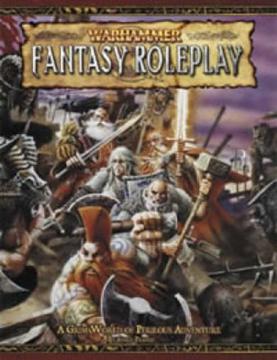
RPG Focus: 2nd Edition Warhammer Fantasy Roleplay (2005)

This week, I want to take a look an all-time great Dark Fantasy tabletop role-playing game, Warhammer Fantasy Roleplay:


"It is a dark time: far to the north, the gate of chaos has opened once more. Archaon, Lord of End Times, had waged his insane war on the civilized world, although he was beaten back at the last moment, Chaos is still prevalent throughout the land: Beasts ravage the countryside, Mutation and Insanity are rife. Heroes are needed, heroes who will beat back the darkness, heroes the like of which who have better things to do than to save inbred, misbegotten peasants like these.
So, you lot will have to do. May the lords of ruination spare your souls..."

With a very British sense of black humor, Warhammer Fantasy Roleplay is set in the grim and perilous Warhammer Fantasy setting, where the power of Chaos lurks in the heart of every person and  simply surviving day-to-day in the midst of various dark and deadly threats is an achievement.  First used by the Warhammer Fantasy Battle tabletop miniatures wargame, world of the Warhammer Fantasy drew inspiration from a number of sources, including Tolkien's Middle-earth, RE Howard's Hyborian Age (Conan the Barbarian), Michael Moorcock's Elric, and early modern European history. 

Warhammer Fantasy Roleplay is only of the best RPGs in terms of capturing the flavor of Dark Fantasy.  Rather than playing (at least in the beginning) badass warriors and powerful wizards, in Warhammer Fantasy Roleplay, the PCs start as everyday scrubs that need to scratch and crawl their way up out of mediocrity, assuming that they don't die in the process.  For example, starting PCs include rat catchers and tax collectors.  Also, regardless of how powerful the PCs become, they can still be taken out by a lucky shot.


The 2nd Edition did a good job of updating and streamlining the 1st Edition.  For example, 2e only uses d10s for resolution.  Thus, similar to Call of Cthulhu, Warhammer Fantasy Roleplay uses a roll under percentile system, so task resolution is straightforward.

However, Character Creation and Advancement is quite crunchy in Warhammer Fantasy Roleplay.  There are 8 primary attributes AND 8 secondary attributes, as well skills and talents (i.e., perks and disadvantages).  This makes creating a PC a lengthy task not easy for a beginner.

Also, as an alternative to leveling, PCs have the ability to shift careers by spending XP.  However, there are around 60 basic careers AND 60 advanced careers.  That's a lot of careers!

In addition, each career has specific career entries and career exits, so one cannot simply go from  rat catcher to noble.  This means that players need to crunch out in advance their career paths if they have a specific goal, similar to the feat system in WotC D&D.


While Character Creation and Advancement is clunky and there are many look up tables to slow down game play, the tremendous flavor of Warhammer Fantasy makes up for it.  The game really is gritty and PCs can die from a single unlucky hit and there's an element of survival horror.  However, under the bleakness, there's a gallows humor and a sense of real accomplishment if you do manage to survive.

So, if you're a roleplaying fan of the Warhammer Fantasy setting, Dark Fantasy, or Horror generally, this may be the tabletop role-playing game for you!

Monday, November 27, 2017

Literature Review: "The Seven Geases" (1934)

This week, I wanted to give a shout out to a really interesting vintage Swords & Sorcery tale, "The Seven Geases":


Written by Clark Ashton Smith (one of the Big Three of the Golden Age of Weird Fiction, alongside RE Howard and HP Lovecraft), "The Seven Geases" is part of the Hyperborean cycle, a fictional prehistoric setting influenced by Smith's friends Lovecraft and Howard that mixes Cosmic Horror with Iron Age technology, and part of the Cthulhu Mythos.

The story follows Ralibar Vooz, a Commoriom noble out to hunt some Voormis, a race of yeti-like bipeds.  Unfortunately for the warrior, he interrupts a sorcerer in the middle of a casting a spell:

"Know that I am the sorcerer Ezdagor," proclaimed the ancient, his voice echoing among the rocks with dreadful sonority. "By choice I have lived remote from cities and men; nor have the Voormis of the mountain troubled me in my magical seclusion. I care not if you are the magistrate of all swinedom or a cousin to the king of dogs. In retribution for the charm you have shattered, the business you have undone by this oafish trespass, I shall put upon you a most dire and calamitous and bitter geas."

As a punishment for his insolence, Ralibar Vooz is magically forced to venture into the depths to seek out the toad-like god Tsathoggua and to offer himself as a sacrifice.  (Un)fortunately, Tsathoggua has no need for the noble as a sacrifice and places a second geas upon him to seek out the spider-god Atlach-Nacha and to offer himself as a sacrifice.  So, once again, Ralibar Vooz battle his way through the darkness and horror, only to have a THIRD geas placed upon him!

This happens four more times.


First published in the October 1934 issue of Weird Tales, this is a fun, witty and well-written read.  I would say that "The Seven Geases" is *TECHNICALLY* a Swords & Sorcery story (in the sense that there are swords and sorcery present) but there's relatively little action.  Instead, the focus is more on Horror and Weird Fiction, as Ralibar Vooz has to put up with a *LOT* of crap.  Moreover, there's a dark sense of humor to this yarn, especially with the highly unexpected ending!

Also, if you like High Gygaxian (e.g., the 1e AD&D DMG), this yarn is filled with obscure SAT words!  Just the first paragraph features scaurs, scoriac, blazonries, and catoblepas!

Speaking of D&D, actually, it's a bit surprising that Messr Smith is absent from Appendix N of the 1e DMG, especially given that Smith's friends Lovecraft and Howard are listed and that "The Seven Geases" is likely the inspiration for the 6th level Geas spell:

Geas (Enchantment/Charm)
Level: 6      Components: V     Range: Touch      Casting Time: 4 segments     Duration: Special      Saving Throw: None     Area of Effect: Creature touched
Explanation/Description: A Geas spell places a magical command upon the creature (usually human or humanoid) to carry out some service, or refrain from same action or course of activity, as desired by the spell caster. The creature must be intelligent, conscious, and under its own volition. While a Geas cannot compel a creature to kill itself, or to perform acts which are likely to result in certain death, it can cause almost any other course of action. The spell causes the geased creature to follow the instructions until the Geas is completed. Failure to do so will cause the creature to grow sick and die within 1 to 4 weeks. Deviation from or twisting of the instructions causes corresponding loss of strength points until the deviation ceases. A Geas can be done away with by a Wish spell, but a Dispel Magic or Remove Curse will not negate it. Your referee will instruct you as to any additional details of a geas, for its casting and fulfilment are tricky. and an improperly cast Geas is null and void immediately (cf. Wish).

That's pretty much how it goes in this story.  There are also other classic D&Disms (e.g., underground action, the astral plane, etc.)

So, if you want to read a terrifying tale from one of the greats of Weird Fiction, check out this  ripping yarn!

Monday, October 30, 2017

Movie Review: Aragami (荒神) (2003)

With All Hallows' Eve soon upon us, this week, I wanted to give a shout out to a rare gem, a spooky samurai film, Aragami:


Directed by Kitamura Ryuhei, "Aragami" is a low fantasy, horror action film featuring badass samurai and philosophical musings.  The movie begins with a pair of seriously wounded samurai who seek shelter from a storm and their enemies in a remote and forbidding temple in the mountains.

Next, one of the previously wounded samurai wakes up to find himself mysteriously healed and that his friend is suspiciously missing.  He then finds that the sole inhabitants of the temple are a sinister warrior and a strangely silent woman.

"Aragami" is not a conventional horror film (there are no jump scares), but it does brilliantly succeed in being mysterious and creepy.  From the beginning, there's a growing unease as it becomes increasingly clear that something is not right about this lonely temple.

As events unfold and the truth is revealed, things are not what they seem, as the samurai is in for a really bad night.


This movie is part of the Duel Project, a challenge issued by producer Shinya Kawai to Kitamura and fellow director Yukihiko Tsutsumi.  The goal was to film a feature-length movie with only two actors, battling in one setting, and to be completed in only one week.

However, despite (or perhaps because of) these limitations, Kitamura manages to put together a film that is both slick and stylish, as well as clever and thoughtful. There's a close feeling, sometimes  intimate, sometimes claustrophobic, sometimes terrifying.

Unsurprisingly, "Aragami" seems a lot like a play, having only a single location and only a handful of characters.  It's quite atmospheric, with thoughtful ruminations on the nature of war and conflict and the boredom of immortality.

There are also lots of nice touches, such as the weird purple glow in the background for most of the movie and the subtle black humor.

The acting and score are excellent.  The fight choreography is also good, if fantastical.


So, if you are a fan of low fantasy, samurai films and/or interesting and clever stories, you owe it to yourself to watch this film!  However, don't just take my word for it.  Here's a link to the film from the director himself!


Monday, July 17, 2017

RPG Focus: 6th Edition Call of Cthulhu (2004)

"Ph'nglui mglw'nafh Cthulhu R'lyeh wgah'nagl fhtagn."

This week, I want to take an Olde School look back on a terrifying classic, Call of Cthulhu, the seminal work in the field of Horror RPGs.


Named after H. P. Lovecraft's story of the same name and drawing upon the eponymous Cthulhu Mythos, Call of Cthulhu (or "CoC" for short) is mostly true to the source material as the PCs (aka "Investigators") take on the role of ordinary people struggling against various dark forces.  I love this setup, as the power level of the game presents real opportunities for true horror, as well as true (if potentially bleak) heroism.

While this discussion specifically covers the 6th Edition, Call of Cthulhu, published by Chaosium and powered by the Basic Role-Playing (BRP) game engine, has remained mostly unchanged over the years since the publication of the 1st Edition of Call of Cthulhu in 1981, which is a testament to the solidity of the BRP ruleset.  Indeed, CoC is one of the best and most influential of the second generation of roleplaying games.

Compared to the contemporaneous AD&D 1E, Call of Cthulhu is faster and simpler game.  It's not quite as streamlined as a modern design, but still easily playable and has a quick learning curve.  In true Olde School tradition, stats are randomly generated, though then there's a point distribution element, based on an Investigator's Intelligence and Education, for skills.  As you might expect, using the RAW some Investigators can have far more skill points than others, so for my own CoC games, I house rule that all Investigators start with the same number of skill points, regardless of Intelligence and Education scores.

With a good Game Master  (aka "Keeper"), the gameplay can be evocative, tense and terrifying as the Investigators explore the mysteries and face the challenges of the Cthulhu Mythos.  As I mentioned above, PCs are fragile (both mentally and physically) and I really like that this leads to more of a Sneak-and-Peak approach, rather than Search-and-Destroy.  This has influenced my campaigns such that the PCs' typical backup plan for any genre is to run away.


The book itself is filled with good advice and, unlike AD&D 1E, isn't written in High Gygaxian, so the writing is clear and to the point.  The book also has lots of neat tidbits to add color and atmosphere (such as a timeline of weird events), as well as random fun things.

So, if you're a roleplaying fan of Lovecraft or Horror generally, I'd suggest taking a look at this tried and true classic!

Monday, October 31, 2016

Music Review: "Don't Worry, We'll Be Watching You" (2011)

Happy Halloween!  In honor of All Hallows' Eve, I wanted to give a shout out to perhaps the creepiest music video I've even seen, "Don't Worry, We'll Be Watching You":


"Just do as we say"

This wonderfully hypnotic and melodic yet super creepy song is the brainchild of Gotye (a pronunciation respelling of "Gauthier", the French cognate of Gotye's given Dutch name "Wouter"), a Grammy winning Australian-Belgian multi-instrumentalist and singer-songwriter.  Known for his creative and unusual compositions, Gotye taps into his dark side with this unsettlingly yet catchy song.

Adding tremendously to the sinister atmosphere of the video are the visuals which were animated and directed by Greg Sharp and Ivan Dixon at the animation studio Rubber House.  They remind me of weirdly experimental music videos from the 1980s, like "Self Control" (1984) by Laura Branigan.

In addition, the cult in "Don't Worry, We'll Be Watching You" therein are pretty much poster children for your typical evil cult.  Also, the bit where the true face of the cult is (literally) revealed sends chills down my spine.


In fact, this video should be watched for inspiration by Keepers before running a session of Call of Cthulhu!