Showing posts with label Culture. Show all posts

Monday, October 22, 2018

Culture: Ancient Olympic Games (776 BC)

When we think about the culture of Antiquity, there's one event that stands out so much that we brought it back in modern times, the Ancient Olympic Games:


Like they are today, the Ancient Olympic Games were the ultimate international athletic competition, as well as a religious celebration of and for the greek god Zeus.  For example, a grand sacrifice of 100 oxen was made to Zeus during the Games.

The first Olympics is traditionally dated to 776 BC and the games were thereafter held every four years.  This measure of time, an olympiad, which became the main unit of time in Greeks historical chronologies.  And, in fact, so important were the Olympics to the Greeks that an Olympic Truce was enacted so that athletes could travel from their cities to the games in safety!

Beginning with just the stade (στάδιον), a foot race, the Ancient Olympic Games became a series of athletic competitions among representatives of Greek city-states.  As noted above, prior to the start of the Olympics, priests of Zeus travelled the land to announce the Games and tell any warring factions to wrap things up.

As long as they met the entrance criteria, athletes from any Greek city-state and kingdom were allowed to participate, with some notable exceptions.  For example, in AD 67, the Roman emperor Nero participated in the Olympics. He bribed organizers to postpone the games for a year so he could participate, and artistic competitions were added to the athletic events.  Unsurprisingly, Nero won every contest in which he was a competitor.  After he died a year later, unsurprisingly, his name was removed from the list of winners.


The Ancient Olympic Games gradually increased to twenty-three contests, although no more than twenty featured at any one Olympiad.  Participation in most events was limited to male athletes except for women who were allowed to take part by entering horses in the equestrian events. 

Unlike today, in the ancient Olympic Games there were no gold, silver, or bronze medals and there was only one winner per event.  This winner was crowned with an olive wreath made of wild-olive leaves from a sacred tree near the temple of Zeus at Olympia. 

The victorious athletes were honoured, feted, and praised. Their deeds were heralded and chronicled so that future generations could appreciate their accomplishments.



Also unlike today, killing your opponent was not forbidden: a victory was only negated if the death was the consequence of breaking the rules (e.g., Kleomedes of Astypalia).

A victorious athlete brought great honour to his home city. The sixth-century BC Athenian statesman Solon promoted athletics by rewarding Athenian victors at the Games financially - an Olympic victor would receive 500 drachmae (for comparison, a sheep was worth one drachma).

As their importance increased, the Ancient Olympic Games became a political tool used by city-states to assert dominance over their rivals.  In this, the modern Games have followed suit (e.g., the US boycott of the 1980 Moscow Olympics and the USSR boycott of the 1984 Los Angeles Olympics).

The Ancient Olympic Games continued to be celebrated when Greece came under Roman rule, until the emperor Theodosius I suppressed them in AD 393 as part of the campaign to impose Christianity as the State religion of Rome... until the modern Olympic Games kicked off in AD 1896 in Athens, Greece!

Citius, Altius, Fortius!

Monday, April 2, 2018

Culture: Beer (~3000 BC)

Last year, I mentioned that eating well is one of things that makes life worth living!

This week, I wanted to take a look at the other side of cuisine and give a shout out to one of the oldest and most widely loved beverages of all time, Beer:


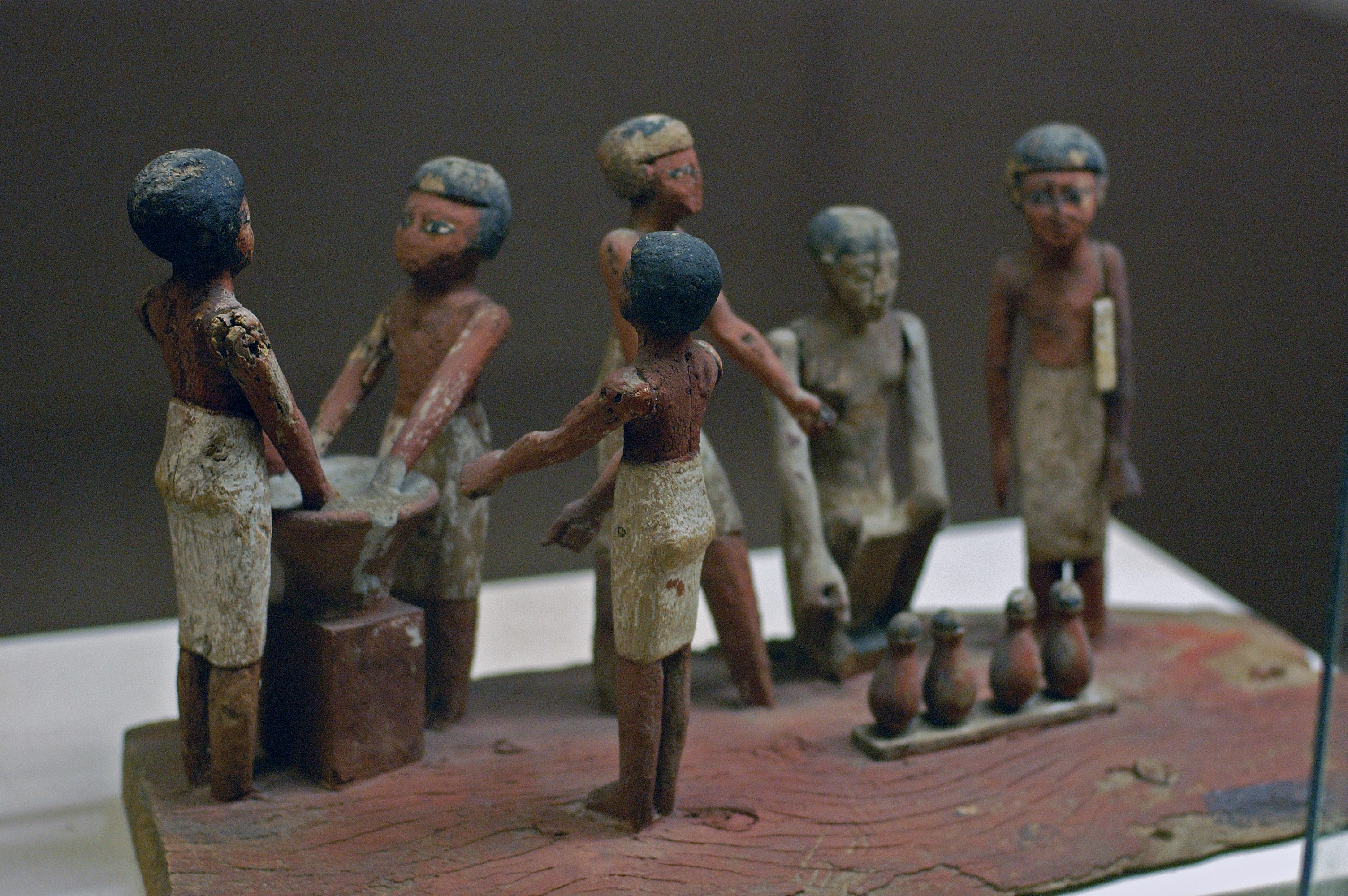
Beer is the third most popular drink in the world after water and tea.  And whether one calls this liquid awesomeness a cold one, a brewskie, or real man's Zima, people have been enjoying beer for a long, long time.  For example, during the building of the Great Pyramids of Giza, each worker got a daily ration of four to five liters of beer, serving as both nutrition and refreshment that was crucial to the Pyramids' construction.

Related to the invention of bread (it is theorized that beer-like beverages were independently developed throughout the world soon after a tribe or culture had domesticated cereal), beer has been arguably partly responsible for humanity's ability to develop technology and build civilization.  Unsurprisingly, the Code of Hammurabi included laws regulating beer and beer parlors.


Fermentation is one of the earliest chemical processes mastered by humanity.  Barley brewed beer has been around since at least 3100 BC, as per archaeological evidence (ancient pottery jars) from Godin Tepe in the Zagros Mountains of modern day western Iran.  

The oldest surviving beer recipe is the "Hymn to Ninkasi," the Sumerian goddess of brewing:

"Given birth by the flowing water ......, tenderly cared for by Ninhursaja! Ninkasi, given birth by the flowing water ......, tenderly cared for by Ninhursaja!
Having founded your town upon wax, she completed its great walls for you. Ninkasi, having founded your town upon wax, she completed its great walls for you.
Your father is Enki, the lord Nudimmud, and your mother is Ninti, the queen of the abzu. Ninkasi, your father is Enki, the lord Nudimmud, and your mother is Ninti, the queen of the abzu.
It is you who handle the ...... and dough with a big shovel, mixing, in a pit, the beerbread with sweet aromatics. Ninkasi, it is you who handle the ...... and dough with a big shovel, mixing, in a pit, the beerbread with sweet aromatics.
It is you who bake the beerbread in the big oven, and put in order the piles of hulled grain. Ninkasi, it is you who bake the beerbread in the big oven, and put in order the piles of hulled grain.
It is you who water the earth-covered malt; the noble dogs guard it even from the potentates (?). Ninkasi, it is you who water the earth-covered malt; the noble dogs guard it even from the potentates (?).
It is you who soak the malt in a jar; the waves rise, the waves fall. Ninkasi, it is you who soak the malt in a jar; the waves rise, the waves fall.
It is you who spread the cooked mash on large reed mats; coolness overcomes ....... Ninkasi, it is you who spread the cooked mash on large reed mats; coolness overcomes .......
It is you who hold with both hands the great sweetwort, brewing it with honey and wine. Ninkasi, it is you who hold with both hands the great sweetwort, brewing it with honey and wine.
[1 line damaged]
You ...... the sweetwort to the vessel. Ninkasi, ....... You ...... the sweetwort to the vessel.
You place the fermenting vat, which makes a pleasant sound, appropriately on top of a large collector vat. Ninkasi, you place the fermenting vat, which makes a pleasant sound, appropriately on top of a large collector vat.
It is you who pour out the filtered beer of the collector vat; it is like the onrush of the Tigris and the Euphrates. Ninkasi, it is you who pour out the filtered beer of the collector vat; it is like the onrush of the Tigris and the Euphrates."

As befits the followers of Ninkasi, many ancient beer meisters in Mesopotamia were women, and making beer was one of the few trades open women at the time.  This is a reflection of the responsibility that women had to supply both bread and beer to the household. 


In contrast with today's brews, ancient beers were often thick, more of a gruel than a beverage, and sometimes early beer drinkers used straws to avoid the bitter solids left over from fermentation.  In addition, some beers contained ingredients that would be unusual to modern beer drinkers, such as berries, honey and narcotic herbs!

But perhaps the biggest difference between ancient beers and modern beers is the latter's use of hops, which started in Germany in the 9th century.  Germany, of course, is home to the most epic of beer festivals, Oktoberfest, which has been held annually for over two centuries!

So, whether you are drinking craft brew or your favorite commercial megabrand, remember that you are doing your own small part to further civilization.  Cheers!

Monday, September 4, 2017

Culture: "The Hero with a Thousand Faces" (1949)

Fundamentally, most tabletop role-playing games seek to tell thrilling yarns about heroes triumphing in the face of great odds.  So, this week I wanted to give a shout out to the seminal work of comparative mythology, "The Hero with a Thousand Faces":


Written by legendary mythologist Joseph Campbell, "The Hero with a Thousand Faces" is a hugely influential study that combines modern psychology with comparative mythological analysis.  Building on work from earlier scholars, Campbell found heroic legends from all over the world and from many different periods of time shares many similar elements of plot, structure, theme and symbolism.  

This begged the question of why heroic legends possessed so many similarities, despite being separated by great gaps of space and time?  Campbell's tremendous insight was that the reason for this universality was that these heroic legends were reflections of and expressions of elements of the collective unconscious of humanity.  According to Campbell and legendary psychologist Carl Jung, the collective unconscious produces "archetypes," which form the basis of many myths.

Furthermore, Campbell was able to break down these heroic legends into a basic narrative pattern which he called the monomyth or "The Hero's Journey", which he summarized as follows:

"A hero ventures forth from the world of common day into a region of supernatural wonder: fabulous forces are there encountered and a decisive victory is won: the hero comes back from this mysterious adventure with the power to bestow boons on his fellow man."


The concept of "The Hero's Journey" has been widely acclaimed since the 1970s.  Moreover, Campbell's ideas have been adopted and adapted repeated in popular culture, perhaps most famously in Star Wars, but also in many, many, many other works.

In the three decades since I discovered The Hero with a Thousand Faces, it has continued to fascinate and inspire me. Joseph Campbell peers through centuries and shows us that we are all connected by a basic need to hear stories and understand ourselves. As a book, it is wonderful to read; as illumination into the human condition, it is a revelation.” - George Lucas

A Call to Adventure!

So, if you are a fan of mythology and want to learn and understand more about the hows and whys of heroic legends, check out one of best written books of the 20th century!

Monday, June 26, 2017

Culture: Chopsticks (筷子) (~400 BC)

Eating is necessary for life but eating well is one of things that makes life worth living!  So, this week I wanted to give a shout out to one of the oldest and most famous eating implements of all time, Chopsticks (筷子):


A common sight at tables throughout throughout East Asia and beyond, chopsticks are sets of two equal length sticks that are used as kitchen and eating utensils.  Usually made of wood, metal, or plastic, chopsticks for eating are typically typically 7 to 10 inches long and are smoothed, with blunt ends, and are frequently tapered.

The Chinese term is 筷子 (pinyin: kuàizi), with the character 筷 combining a phonetic part meaning "quick" (快), and a semantic part meaning "bamboo" (竹).  However, the origin of the English name is a mystery: "chopstick" may be derived from Chinese Pidgin English, in which "chop chop" means "quickly".  

Held in the dominant hand, between the thumb and fingers, chopsticks are to pick up pieces of food and thus require more dexterity than knife and fork, which are typically used in Europe and the Americas.  However, with practice, most people can gain proficiency.


According to the California Academy of Sciences, the first "chopsticks" developed in China around 5000 years ago and were twigs used as cooking utensils for stirring fires, reaching deep into boiling pots of water or oil, etc.  Later, around 400 BC, chopsticks became popular as eating utensils when,  as a result of a population boom, resources became scarce.  Consequently, chefs began cutting food into small pieces which would cook more quickly to conserving fuel.  Thus, the need arose for eating implements capable of easily handling these small pieces.  

In addition, the spread of Confucianism may have also played a part in popularizing chopsticks.  Being a vegetarian, Confucius taught, “The honorable and upright man keeps well away from both the slaughterhouse and the kitchen. And he allows no knives on his table.”  The great sage thought that using knives as eating utensils evoked violence and warfare, and therefore discouraged such use.


By 500 AD, chopsticks had spread to Japan, Vietnam and Korea as a result of Chinese cultural influence, although early Japanese chopsticks were used only for religious ceremonies.  In the intervening millennia, chopsticks have also become widely used wherever expatriate Chinese traveled.

So, if you are using chopsticks, remember that you are enjoying a meal the same way that billions of people have done for thousands of years.  Just don't stick them vertically into rice, which is bad luck as it is similar to incense at funerals!


Monday, April 17, 2017

Culture: Code of Hammurabi (1754 BC)

Law is a cornerstone of civilization.  So, this week I wanted to give a shout out to one of the oldest and most influential law texts of all time, the Code of Hammurabi:


Officially consisting of 282 laws (although there is no 13th Law because, then as now, the number 13 was considered to be unlucky), the Code of Hammurabi is a monumental achievement.  Not only is the Code both one of the earliest forms of law and one of the earliest examples of lengthy writing, it stands for the notion that human behavior should be regulated with justice and fairness (for example, the Code contains one of the earliest examples of the presumption of innocence), although Babylonian notions of "justice" and "fairness" were different from modern views.

In addition, the Code supported the notion that the law is meant to be open and accessible: the Code was written in Akkadian, the daily language of Babylon, and was inscribed on a stele and placed out in public, so any literate person could read it.   Over half of the Code covers commercial transactions, and a third deals with family matters but the text is far ranging and it also is one of the earliest examples of a fundamental law (i.e., a constitution).  

Named after the great Babylonian king who extended Babylon's control throughout Mesopotamia, the Code of Hammurabi was enacted because Hammurabi had conquered many disparate peoples and wanted to have a uniform set of laws to help administer and unify his new empire.


One of the most famous (and misunderstood) laws in the Code is #196: "If a man destroy the eye of another man, they shall destroy his eye."  However, the purpose of the law was to *RESTRICT* compensation to the value of the loss.  Thus, it is more accurately read as "only one eye for one eye."

My favorite law from the Code is #5:
If a judge try a case, reach a decision, and present his judgment in writing; if later error shall appear in his decision, and it be through his own fault, then he shall pay twelve times the fine set by him in the case, and he shall be publicly removed from the judge's bench, and never again shall he sit there to render judgement.

Government accountability is always a good thing.


Written nearly four millennia ago, the Code of Hammurabi has long since passed into the public domain and several English-language translations can be found here.