Showing posts with label Historical Adventure. Show all posts

Monday, November 19, 2018

TV Review: "The Last Kingdom" (2015-)

This week, I want to give a shout out to arguably the best historical adventure show presently on the air, "The Last Kingdom":


Based on Bernard Cornwell's "The Saxon Stories" series of historical novels, "The Last Kingdom" is a historical adventure television series that tells the tale of King Alfred the Great and the rise of England, as experienced by the protagonist Uhtred of Bebbanburg, a noble from Northumbria who became a Viking slave then son to his Viking owner then independent warrior.


Monday, July 2, 2018

Movie Review: Mongol (2007)

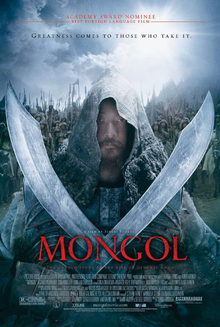
This week, I wanted to give a shout out to another overlooked Historical Adventure gem, "Mongol":


"Mongols need laws.
I will make them obey...
...even if I have to kill half of them."

Also known as "Mongol: The Rise of Genghis Khan", "Mongol" unsurprisingly covers the early life and rise to power of Genghis Khan (under his given name Temüüjin), who conquered the largest land empire in history.  The story begins with 9-year-old Temüjin on a trip by his father Yesugei, a Mongol chieftain, to select a girl as his future wife.

Although his father wishes him to choose someone from the rival Merkit tribe in order to make peace, along the way Temüjin meets Börte, a girl from another tribe.  Impressed with Börte's pluck, he picks her instead.  Shortly thereafter, disaster strikes when Yesugei is poisoned by another group of rivals.

This begins a sequence when Temüjin is periodically on the run and captured.  During this time, he becomes blood brothers with another young boy named Jamukha and Börte gives birth to two children of questionable parentage.  Eventually, Temüjin raises an army to unify all of the Mongols, and meets his blood brother, now a powerful warlord in his own right, for a final showdown.


While Genghis Khan is the national hero of Mongolia (where he is still revered to the present day), his reputation in other parts of the world is... mixed.  However, rather than portray Temüüjin as a cartoon villain or sociopathic mass murderer, director Sergei Bodrov instills sympathy and humanity, which is easier since the film depicts the period prior to Genghis Khan's major genocides and atrocities.

In any event, "Mongol" is a sweeping epic historical film, with beautiful cinematography, stunning landscapes, and powerful battle scenes.  There's plenty of carnage but the film is also balances with quiet character moments that give a sense of Temüüjin as a person and family man.


Blending action, politics, romance, and brotherhood,  "Mongol" is both a grand and an intimate movie that is successfully both entertaining and dramatic. 

So, if you're looking for a David Lean-style Epic that's also a not-over-the-top action flick, this may be the film for you!

Monday, June 11, 2018

Movie Review: Spartacus (1960)

This week, I wanted to give a shout out to the film that set the standard for every big budget Sword & Sandal movie that followed, "Spartacus":


Produced and headlined by legendary actor Kirk Douglas and directed by the legendary Stanley Kubrick, "Spartacus" is loosely based upon the historical figure of the same name and events of the Third Servile War (73–71 BC).

The film opens with the gifted but rebellious Spartacus sentenced to death for attacking a guard in a hard labor mine but spared after Roman businessman Lentulus Batiatus purchases the fiery slave for his gladiatorial school in Capua.  There, he becomes a skilled combatant and meets his love interest, Varinia.

Once day, two powerful Roman nobles and their wives visit the gladiatorial school and demand a pair of death matches.  One of the nobles is the general and politician Marcus Licinius Crassus, who would later form the First Triumvirate with his rival Pompey the Great and his political and financial client Julius Caesar.

The death matches upset the gladiators, who rise up and kill their handlers, and soon the rebellion engulfs southern Italy.  Spartacus leads his new slave army to early victory over the Romans, but betrayal forces a decisive showdown with new legions led by Crassus.


A thoughtful film, Spartacus isn't a ripping Sword & Sandal yarn.  Some of the proselytizing is heavy-handed, but the political scenes are handled deftly, as are the battle scenes.  The acting style is also a product of its time.

Overall, the film was a critical and commercial success.  Winner of 4 Academy Awards, Spartacus also ended the Hollywood blacklist when Kirk Douglas demanded that screenwriter Dalton Trumbo be credited under his own name and President-elect John F. Kennedy crossed American Legion picket lines to view the film.

So, if you're looking for an Epic in the old Hollywood tradition (Spartacus has a cast of over 10,000 and a 3 hour 20 min runtime, including overture and intermission), this may be the film for you!

Monday, March 19, 2018

Movie Review: "Hero" (2002)

Much like there were many Swords & Sorcery films released in the wake of the epic "Conan the Barbarian" (1982), there were a number of Wuxia movies at the turn of the century that sought to capitalize on the popularity of "Crouching Tiger, Hidden Dragon" (2000).

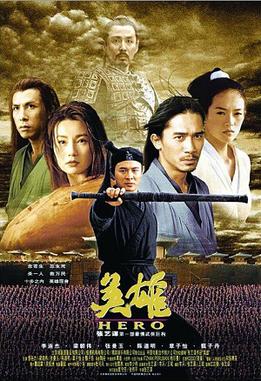
This week, I wanted to take a look at one of the better efforts, "Hero" (2002):


Very, very loosely based on the story of Jing Ke's assassination attempt on the King Zheng of Qin (who would go on to become Emperor Qin Shi Huang, founder of the Qin Dynasty) in 227 BC, "Hero" is a low fantasy historical adventure film by "Fifth Generation" director Zhang Yimou.

Set in the Warring States period of China, the story follows a nameless swordsman (appropriately named Nameless), a minor government official who purportedly has killed three assassins (Sky, Snow, Broken Sword) who have been giving King Zheng sleepless nights and caused him to take drastic security measures.  This gets Nameless an audience with the King and what follows is a cat and mouse game between the two, and we see various versions of the events (a la Rashomon (1950)), as the King drills down to the surprising truth.


Compelled to surpass "Crouching Tiger, Hidden Dragon" (directed by Taiwanese multiple Academy Award winner Ang Lee) out of nationalistic pride, "Hero" was the most expensive mainland Chinese film to that date, with an all-star cast headlined by legendary martial arts star Jet Li and including Hong Kong staples Tony Leung and Maggie Cheung, "Crouching Tiger" starlet Zhang Ziyi and long time mainland Chinese actor Chen Daoming.

"Hero" has solid wuxia action, especially between Li and fellow action star Donny Yen.  The other action scenes are more dreamlike, but are still fine.  One of the best parts of the film is the amazing cinematography, featuring amazing landscapes and gorgeous use of color.

However, the story has some issues, not the least of which is, without completely spoiling the ending, that this movie was unsurprisingly criticized in the West as being pro-authoritarian.  By this, I mean that, unlike the position taken by the film, the people of the Warring States didn't really have a sense of being part of one country at that time, while the film has a clear message of the importance of sacrificing lives and liberty in favor of central power.

Unsurprisingly, this is exactly the message that the Chinese Communist Party pushes.  And, as Director Zhang Yimou is a loyal member of the Communist Party, it's not surprising that he was awarded the prestigious position of directing the Opening Ceremonies of the 2008 Beijing Olympics.


Anyway, "Hero" is a fine entry in the wuxia genre.  However, take its historicity with a giant boulder of salt and it's better to enjoy the film as pretty but vapid entertainment.

Monday, January 8, 2018

Movie Review: 47 Ronin (2013)

This week, I wanted to take a look at a Flawed but Fun retelling of the epic true story of the forty-seven rōnin (四十七士 Shi-jū-shichi-shi, forty-seven samurai), "47 Ronin":


Based on the Akō incident (赤穂事件 Akō jiken), which is celebrated each year on December 14, "47 Ronin" is a fictionalized version of Akō incident that's further been reskinned as a Sword & Sorcery yarn.  This film follows the viewpoint of the fictional character Kai, a half-Japanese, half-English foundling who possesses certain preternatural abilities courtesy of being raised by the Tengu, which are Japanese spirits/demons.

Kai flees the Tengu and is found and raised by Lord Asano Naganori of the Akō Domain.  Although an outsider to the others of Lord Asano's household, Kai is treated kindly by the Lord and his daughter, Mika, with whom there's a predictable forbidden romance subplot.  Years later, Lord Asano is framed for the attempted murder of the rival Lord Kira (in real life Kira Yoshinaka was a high ranking government official rather than a rival lord) by witchcraft and is forced to commit seppuku (切腹, "cutting [the] Stomach/belly"), a form of Japanese ritual suicide by disembowelment.

Consequently, Lord Asano's samurai become ronin (masterless warriors), which drives the rest of the film.  Despite being specifically forbidden to seek revenge against Kira, the 47 Ronin (including Kai) carve a bloody path through anyone who stands in their way to avenge their fallen lord.


Overall, this movie is a mixed bag.  "47 Ronin" is serviceable as a popcorn flick and is a decent a Sword & Sorcery film, but there's no gravitas to the movie as there probably should be for a story (the Akō incident) that has become synonymous with loyalty, sacrifice, persistence, and honor in Japan.    The plot of "47 Ronin" is pretty much by numbers and Lord Kira is a 2D baddie (the film probably should have focused more on the witch, playing by Kikuchi Rinko, who at least did a fun job of chewing scenery).

By contrast, Keanu Reeves' acting as Kai is, as usual outside of a few roles, is pretty flat and doesn't do a good job of carrying the movie.  The production design is good and the action sequences are fun but not particularly memorable.  Some of the CGI looks bad.


I think that the accusations of "whitewashing," which likely affected the film's box office performance, are overblown in this particular case: while Kai is the main character of the film, his actions and abilities are explained in the Sword & Sorcery context and he doesn't particularly overshadow the other characters.

If anything, this movie should have more fully embraced and explored the supernatural and eldritch parts of Japanese myth and folklore, which would have made the film more distinctive.


Monday, December 25, 2017

Movie Review: Ben-Hur (1959)

Happy Holidays!

This week, I wanted to give a shout out to arguably the most epic (in several senses of the word) movie of all time, "Ben-Hur":


A remake of the 1925 silent film of the same name, which in turn was adapted from General Lew Wallace's 1880 novel, Ben-Hur is an inspirational tale of betrayal, torment, vengeance and redemption.  A sweeping historical drama that also manages to be intensely personal (director William Wyler dubbed the movie "Hollywood's first intimate spectacle"), the film successfully combines period drama, action, politics, and romance.

Set in the time of Jesus Christ, Ben-Hur has a clever double narrative that begins with the birth of Jesus and follows the future messiah into young manhood before shifting to Judah Ben-Hur, a Prince of Judea.  The titular character is reunited with his childhood friend, Messala, who returns as the new commander of the Roman garrison in Jerusalem and who is second in authority only to the provincial governor.

Messala is eager to use his friendship with Judah to cement Roman authority, only to be rebuffed.  Later, the tables are turned after Judah's sister accidentally injures the governor and the spurned Messala sentences Judah to slavery on a galley and his sister and mother to the dungeon.  En route to the gallery, Judah nearly dies of thirst after being denied water by a cruel guard when a young carpenter gives the new slave a drink and stares down the guard.


After a twist of fate leads to Judah's freedom, he returns home and, believing his sister and mother are dead, challenges Messala to a brutal chariot race, where anything goes, including allowing the Roman to ride a scythed chariot!   The tribune's attempt to carve up Judah goes poorly and he ends up trampled to death by another racer.  However, before passing, Messala smugly tells Judah that "the race is not over" and informs him that his sister and mother are not dead, but rather lepers.

Judah brings his sister and mother to Jerusalem to see a young rabbi preaching peace, only to find that 1) the rabbi has been sentenced to crucifixion and 2) he is the man who gave Judah water years before.  Judah witnesses the crucifixion, learning to let go of his hate, while his sister and mother miraculously healed.


This is a monumental (in several senses of the word) film!  Not just worthy successor to the 1925 film, Ben-Hur was an enormous financial and critical success, the highest-grossing movie of the year that won a record 11 Academy Awards (Titanic (1997), tied the record nearly 40 years later)!

Intelligent, engaging, exciting, and dramatic, Ben-Hur has stood the test of time as a landmark film.  In the classic style, there's both an overture and an intermission, breaking up the running time of 212 minutes.  However, the movie never drags yet still allows scenes time to breathe.

Miklós Rózsa composed the longest ever film score, which remains influential.  However, there's no music in the dramatic parts (e.g., leprosy), relying on the strength of the acting and allowing the audience to reach their own conclusions, whereas a lesser film would use musical cues to tell the audience what to feel.

Ben-Hur also successfully treads a fine line.  The movie deals with intensely Christian subject matter, but director William Wyler succeeds in making a film that appeal to anyone.  Additionally, Wyler used Jesus sparingly and didn't show the face or voice of the messiah, only other people's reactions.  This allows the viewer's imagination to fill in the rest.

Ramming speed!

With MGM facing bankruptcy, the studio bet the house on this film!  This was most expensive movie in history at the time, with a final production budget of over $15 million (more than double what was planned).  It featured more crew and extras than any other film before it - over 10,000 extras alone for the stunning chariot race sequence.

MGM built over 300 sets (some of which took more than a year to complete), including the 2000 foot long Circus (i.e., racing stadium) and filled it with thousands of costumed extras, giving the film a verisimilitude that CGI simply cannot match.

Additionally, Ben-Hur was shot in 65mm, cutting edge technology for the time.  These wide shots, combined with the restrained use of close ups, added to the epic feel while also revealing a huge amount of detail, adding to the sense of realism.  The film also featured graphic violence for the time (e.g, dismemberment, trampled to death by horses, etc.)

It was a grueling shoot.  By the end of the production more than 1,000,000 pounds of plaster and 40,000 cubic feet of lumber were used.  With the fate of the studio on the line, producer Sam Zimbalist died of a heart attack from the constant and mounting pressure.


So, if you want to see thoughtful and eloquent storytelling that is both moving and uplifting, check out this all-time great flick!

Monday, November 13, 2017

Movie Review: Hercules, Samson and Ulysses (1963)

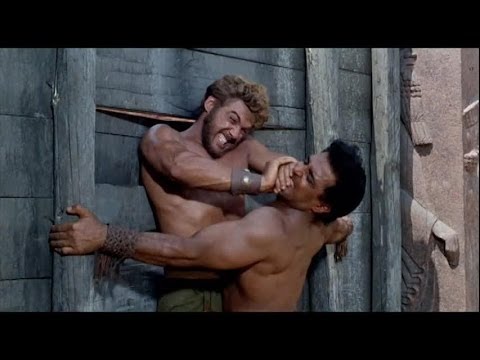
This week, I wanted to give a shout out to a ripping Sword & Sandal yarn that puts together two great tastes that taste great together and that kicks more butt than you can shake a Bible at, "Hercules, Samson and Ulysses":


Exotic lands!  Dangerous women!  Evil tyrants!  Legendary heroes!  Mighty thews!  This movie has it all!

The action begins in Ithaca, where a fearsome sea monster (*cough*sea lion*cough*) is ravaging the coast.  Brave Hercules, crafty Ulysses and a few redshirts ship out to stop the beast but end up shipwrecked in Judea!  Meanwhile, Samson is hiding out from the Philistines for killing a number of their men and generally resisting their rule.

Then, there's a bit of mistaken identity when Hercules slays a lion with his barehands, since only one guy is supposed to be able to do that...

Meanwhile, the Philistine King engages in a bit of ethnic cleaning and kidnaps Hercules' friends, with the help of sexy troublemaker Delilah.  To free them, Hercules has to bring in the rebel Samson, setting up the epic no holds barred smackdown of the ages!


Made toward the end of the golden age of peplum films, "Hercules, Samson and Ulysses" is as good (or bad) as you might expect.  This is fun film about manly men and superheroes teaming up to fight evil.  It is a (mostly) lighthearted romp that is gloriously and unabashedly cheesy (e.g, there's an obvious English language dub, the "rocks" are clearly Styrofoam, etc.) but in a way that simply adds to the charm.

The story is straightforward but not aggressively stupid.

The fight scenes are good in a chop socky way and the acting is played straight is mostly effective, with some fun flirting between Hercules and Delilah.  Also, it is super nice to see real sets and animals rather than CGI!  And the ladies are easy on the eyes.


So, if you want to see big, beefy, sweaty dudes wrestling in a totally not homoerotic way, check out this classic flick!

Monday, August 7, 2017

Movie Review: Gladiator (2000)

This week, I wanted to take a look at the film that's kicked off the latest round of Historical Epic and Sword & Sandal romps, "Gladiator":


First of all, I want to state up front that calling this movie "historical" has to be taken with a gigantic asteroid of salt!  Anyway, "Gladiator" follows the rise and fall... and rise of the fictional Maximus Decimus Meridius as he transitions from general to slave to the titular gladiator.

The film begins with the final battle of the Marcomannic Wars, which ends with a decisive Roman victory by Maximus while Emperor Marcus Aurelius watches.  Afterward, Marcus Aurelius declares to his son, Commodus, that the latter will not be Emperor (NB- this didn't happen in real life) because the former wants to dissolve the Empire and to restore the Roman Republic (NB- this didn't happen in real life).  However, rather than enjoying his much longed for peace, the Emperor instead enjoys being smothered to death by Commodus (NB- this didn't happen in real life).

Maximus is not down with this regime change and attempts a coup d'etat.  However, wily Commodus  remains one step ahead and Maximus ends up a slave after his family is murdered.  The former general is sold and trained as a gladiator and proves to be unstoppable!


Meanwhile, Commodus decides to host a massive and hugely expensive series of gladiatorial fights to distract the populace from the failings of his rule.  As the A #1 hotshot, Maximus and his friends are off to Rome.  This sets up a collision course between the two men that can only be settled with cold steel on the hot sand of the Colosseum!

While it won Best Picture at the Academy Awards (robbing Crouching Tiger, Hidden Dragon IMHO), "Gladiator" basically just a fun popcorn flick.  The movie has excellent action scenes, high production values and a wonderful score.  Additionally, it deserves credit for reinvigorating the Historical Epic and Sword & Sandal genres and increasing the public's interest in history generally.


However, director Ridley Scott again shows his inability to elevate source material: when he has a great script, he can produce a great movie (e.g., Alien, Blade Runner, Thelma & Louise, Black Hawk Down, The Martian).  When the scripts are not great, his films are stylish and visually stunning but not much else.  This is the case here, as "Gladiator" is ultimately a vapid tale filled with forgettable characters. 

So, if you're looking for a ripping Sword & Sandal yarn, this movie is just fine.  But if you're looking for a somewhat more historical take on ancient Rome, the HBO television series is much, much better in every other category.

Thirteen!

Monday, February 6, 2017

Movie Review: "Detective Dee and the Mystery of the Phantom Flame" (2010)

[NB- this post is a slightly revised version of one that I published earlier]

春節快樂!

As we are in the midst of the 15 days to celebrate Chinese New Year (aka Spring Festival), I wanted to give some props to my favorite Chinese action mystery film, Detective Dee and the Mystery of the Phantom Flame:


Set in Tang Dynasty China, at the beginning of the reign of Wu Zetian (武則天), the first and only Chinese empress to rule in her own name, the country is rife with plots and intrigue against the throne.  After a couple of officials spontaneously combust (the titular flame), the Empress releases her old foe, former imperial magistrate and rebel Di Renjie (狄仁傑, the titular character), from prison and orders him to get to the bottom of this baffling mystery.  This, of course, is easier said than done, not only because of the tangled schemes of the Empress and other political factions, but also because Di's own assistants, Officer Shangguan Jing'er and Officer Pei Donglai, have interests that are not entirely aligned with the good detective's.  The result is an excellent series of twists and turns where you're not sure who's playing whom.

Like Guy Ritchie's excellent Sherlock Holmes films, to which it is often favorably compared, Detective Dee and the Mystery of the Phantom Flame is a multi-genre reimagining of a classic character, who in turn is based on the actual Di Renjie, a celebrated Chinese official.


Directed by the acclaimed Tsui Hark and with a large (by Hong Kong standards) budget, Detective Dee and the Mystery of the Phantom Flame is a lavish historical thriller that works as both a detective movie and a martial arts flick.  The set and costume design are gorgeous, while the story is breezy fun with just the right amounts of suspense, spookiness and mysticism.  And with the legendary Sammo Hung as action director, you know the fight choreography will be top notch.

Leading a stellar cast, the great Andy Lau plays the titular detective with intelligence, wit, and aplomb.  Furthermore, to prepare for his role in the film, Lau studied criminal psychology, which adds to the verisimilitude as Detective Dee conducts his investigation.  In addition, giving the detective a strong cast of characters to play against elevates the work: Detective Dee's verbal jousts with the Empress, played by Carina Lau, Andy's wife, in her first film role in four years, are some of the best scenes in the movie.


All in all, Detective Dee and the Mystery of the Phantom Flame is an excellent film.  If you would like to watch a Chinese martial arts film or historical drama with unexpected depth and superb execution, you could do a lot worse than this gem.

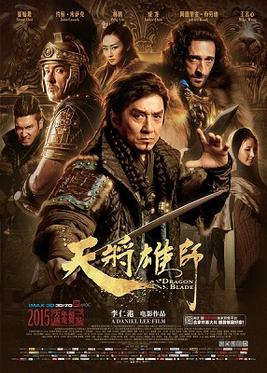
Movie Review: "Dragon Blade" (2015)

This week, as we are in the midst of the 15 days of celebration for Chinese New Year, I wanted to take a look at the entertainingly bad Chinese historical adventure film "Dragon Blade" (2015):


In this world, is the destiny of mankind controlled by some transcendental entity or law? Is it like the hand of God hovering above? At least it is true that man has no control; even over his own will.

This is a work of historical fiction, with a strong emphasis on "fiction".

no killing rule

childish

surprisingly no bad
twists and turns in the plot

Jackie Chan plays the captain of the Han Chinese government's Silk Road Protection Squad (even though there was no such thing), John Cusack plays the Roman general of the "Black Eagle Corps" (even though Roman military units were not organized into corps), and Adrien Brody plays the son of Marcus Licinius Crassus, who murders his father to become Consul of Rome (even though that's not how Crassus died or though Consul was not a heretitary position).

there are also many, many, many other liberties taken 

it's a Chinese imagining of Ancient Rome, like the portrayals of Native Americans in old westerns.


one of China's most expensive films

cheesy hammy overacted

terrible editing


And so begins this ripping yarn that masterfully combines an epic dark fantasy narrative, ridiculously awesome action and philosophical musings!  An adaptation of the best-selling manga with the same name, "Berserk" follows a young mercenary named Guts as he (literally) carves his way through a low fantasy world reminiscent of late medieval/early renaissance Europe.  This unfortunate place is plagued with constant warfare and endures a level of everyday violence and brutality that makes Westeros seem like Disneyland!

Confusingly, this anime starts with an episode in the manga's Black Swordsman arc then quickly shifts back to the manga's Golden Age arc, where Guts is recruited by the brilliant and charismatic leader of the Band of the Hawk mercenary group, Griffith.  The viewer follows the Band of the Hawk's rise to glory among various blood-soaked battlefields, while Griffith plays a devious and equally deadly game of political machinations.


In addition to enough blood and violence to trigger a moral panic, Beserk features an amazing soundtrack that, fittingly, highlights or underscores the narrative.  Furthermore, the narrative is filled with excellent character beats, such that even minor characters get some surprising depth.  This more than makes up for animation quality that is average, at best, for the time.

In the Golden Age arc, Guts and the Band of the Hawk face danger, betrayal and demonic shenangians at every turn.  Fortunately, Guts possesses effectively unlimited willpower, a zero [expletives] given attitude, and arguably the coolest sword of all time!  This sucker is so huge it makes a daiklave from Exalted look like a kid's toy!


Really, the only major flaw to "Berserk" (1997) is that it ends on an epic cliffhanger... which was addressed by the new series "Berserk" (2016) currently airing in Japan, that picks up immediately afterward!