Monday, March 19, 2018

Movie Review: "Hero" (2002)

Much like there were many Swords & Sorcery films released in the wake of the epic "Conan the Barbarian" (1982), there were a number of Wuxia movies at the turn of the century that sought to capitalize on the popularity of "Crouching Tiger, Hidden Dragon" (2000).

This week, I wanted to take a look at one of the better efforts, "Hero" (2002):
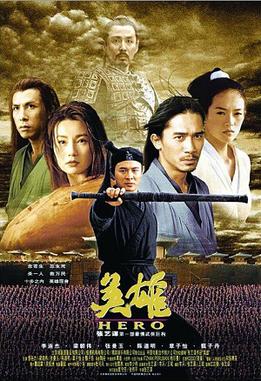


Very, very loosely based on the story of Jing Ke's assassination attempt on the King Zheng of Qin (who would go on to become Emperor Qin Shi Huang, founder of the Qin Dynasty) in 227 BC, "Hero" is a low fantasy historical adventure film by "Fifth Generation" director Zhang Yimou.

Set in the Warring States period of China, the story follows a nameless swordsman (appropriately named Nameless), a minor government official who purportedly has killed three assassins (Sky, Snow, Broken Sword) who have been giving King Zheng sleepless nights and caused him to take drastic security measures.  This gets Nameless an audience with the King and what follows is a cat and mouse game between the two, and we see various versions of the events (a la Rashomon (1950)), as the King drills down to the surprising truth.


Compelled to surpass "Crouching Tiger, Hidden Dragon" (directed by Taiwanese multiple Academy Award winner Ang Lee) out of nationalistic pride, "Hero" was the most expensive mainland Chinese film to that date, with an all-star cast headlined by legendary martial arts star Jet Li and including Hong Kong staples Tony Leung and Maggie Cheung, "Crouching Tiger" starlet Zhang Ziyi and long time mainland Chinese actor Chen Daoming.

"Hero" has solid wuxia action, especially between Li and fellow action star Donny Yen.  The other action scenes are more dreamlike, but are still fine.  One of the best parts of the film is the amazing cinematography, featuring amazing landscapes and gorgeous use of color.

However, the story has some issues, not the least of which is, without completely spoiling the ending, that this movie was unsurprisingly criticized in the West as being pro-authoritarian.  By this, I mean that, unlike the position taken by the film, the people of the Warring States didn't really have a sense of being part of one country at that time, while the film has a clear message of the importance of sacrificing lives and liberty in favor of central power.

Unsurprisingly, this is exactly the message that the Chinese Communist Party pushes.  And, as Director Zhang Yimou is a loyal member of the Communist Party, it's not surprising that he was awarded the prestigious position of directing the Opening Ceremonies of the 2008 Beijing Olympics.


Anyway, "Hero" is a fine entry in the wuxia genre.  However, take its historicity with a giant boulder of salt and it's better to enjoy the film as pretty but vapid entertainment.

Monday, March 12, 2018

RPG Design: Thief Skills

A couple years ago, I discussed the Thief Class and the importance of Balancing Skills,  and last year, I discussed the importance of Balancing Classes.

This week, I wanted to riff off those discussions and take a look at the mechanic for Thief Skills in 2nd edition AD&D compared to earlier editions.  Like earlier editions, in 2e, there is a chart stating the base scores for Level 1 Thieves, to be modified by Dexterity, race, and armor, if applicable.


Then, however, the Player gets to do something pretty different for TSR D&D:

"Each time the thief rises a level in experience, the player receives another 30 points to distribute. No more than 15 points per level can be assigned to a single skill, and no skill can be raised above 95 percent. including all adjustments for Dexterity, race, and armor. As an option, the DM can rule that some portion of the points eamed must be applied to skills used during the course of the adventure."

I've mentioned before that 1st edition AD&D is my favorite iteration of Ye Auld Fantasy Game, but I do really like the 2e approach to Thief Skills.  It is basically a type of Point Buy for character advancement that allows the player to customize to suit in this area, while still retaining the archetypal flavor benefits of using a class.

This is able to work with Old School D&D since the OD&D game engine is robust enough to have multiple independent sub-systems, which in turn means that DMs can mix and match sub-systems as desired with limited or no mechanical repercussions (e.g., changing Thief Skills has no knock effect on combat mechanics).


Inspired by the mechanic for Thief Skills in 2nd edition AD&D, in my own rules set, I have added a skills system influenced by Call of Cthulhu, allowing players to customize their characters to a much higher degree than in Ye Auld Fantasy Game.

Monday, March 5, 2018

Video Game Review: "Darkest Dungeon" (2016)

I wanted to give a shout out to arguably the best recent CRPG, "Darkest Dungeon"!


Developed by Red Hook Studios (the moniker being a sign of their Lovecraft fandom!), Darkest Dungeon is a low fantasy dungeon crawling and team management CRPG.  In terms of background, in the finest Lovecraftian tradition, The Ancestor of the player spent too much time delving into Things Man Was Not Meant To Know, hordes of monstrosities were subsequently unleashed and now it's up to the player to set things right.

Dungeon by brutal dungeon, you direct a legion of adventurers to clear your blighted estate, often at the cost of the latters' lives and/or sanity, until you face the eponymous Darkest Dungeon.

Like the grim and gritty setting, this is a grueling and challenging game, in large part because, in the best Old School tradition, Random Number Generation (RNG) has a huge impact on gameplay!  More than once, a string of bad die rolls will turn the situation upside down and you'll be screaming  in frustration at the screen.


In a big departure from the majority of dungeon crawlers, in this game, much like a soccer manager, you are more focused on developing an entire roster of adventurers to meet various goals and challenges, as opposed to leveling up a specific party.  If you miss the forest for the trees, it's easy to get too invested in a particular  adventurer or group of adventurers, spending way too much resources on them.

Mixing side scrolling movement (a la Castlevania (1986), Old School!) and turn-based combat, tension mounts palpably as you explore various procedurally generated dungeons and the hordes of opponents whittle away at the party's health and sanity, not unlike Call of Cthulhu!


There's little hand holding in this game, and one poor decision can cost you, so you need to constantly pay attention (who's attacked so far this round?) or the situation can quickly devolve into a TPK!  Moreover, this is another way that the game punishes you if you get too invested- if a dungeon delve is going poorly, sometimes it's better to cut bait and run than risk ruining or losing one or more characters to death or insanity.

In addition, between the classes, their skills and camping skills, quirks, dungeons, monsters, curios, etc., there's a *HUGE* amount of crunch to absorb, so don't feel like looking things up in the wiki is cheating!  In addition, FilthyRobot has put together an excellent and informative series of class guides, beginning with the Abomination:


Overall, Darkest Dungeon is an amazing Old School game!  It rewards planning, preparations and smart play, but sometimes stuff happens and you just have to bounce back.  The art style is apt and the artwork is moody and evocative, as is the voice acting, and the attention to detail is superb.

So, if you are looking for an intense, Old School dungeon crawler that demands your best and keeps you on your toes, you'll love (and, at times, love to hate) "Darkest Dungeon".

Monday, February 26, 2018

RPG Events: TotalCon 2018

Like last year, I again attended this year's TotalCon!


And again, for the most part, much fun was had, although there were a couple notable hiccups this time:

Firstly, there was an enormous line to receive my con documents, since a bunch of people showed up during lunchtime and there was only one person processing attendees (there are a second person at the door to the registration room who basically wasn't doing anything very productive and apparently wasn't able to also process attendees), so it took an inordinate amount of time and I nearly missed a game.

Secondly, I did unfortunately have a game during the con that featured my two biggest RPG pet peeves: 1) railroading, and 2) player v. player, better known as PvP (which led to a TPK)!  Some people may enjoy those, but not me.

Particularly, the PvP was in the form of a plant among the players who had his own agenda.  This, IMHO, is especially unfair in a convention setting because, even if one suspects something is going on, does one act?  What if you are wrong and you kill the PC?  Will that ruin the game for someone who paid attendance?


Another thing that was somewhat negative was that, during my Astonishing Swordsmen & Sorcerers of Hyperborea game, once again  I called out the "twist" that the hidden enemy were Snake Men.  But, at least the scenario wasn't a poorly done rip off of RE Howard's classic Conan yarn "Shadows in Zamboula"!


Nevertheless, overall, I thought TotalCon 2018 was quite a good time.


I did have the chance to play the Legend of the Five Rings RPG for the first time, which was interesting.


Legend of the Five Rings (usually abbreviated L5R) began as a card game.  The RPG uses a "roll and keep" dice pool mechanic (like Exalted, only d10s) where the player seeks to roll over a target number (unlike Exalted, in which the player counts successes).  There's an interesting "raise" mechanic, where the player can voluntarily increase the target number in exchange for greater success.

L5R is set in the fictional empire of Rokugan, which is a faux feudal Japan with a smattering of other influences.  The background is quite detailed and really adds a lot to the experience by providing deeper character immersion.


I also got a chance to get in a bunch of Old School play with my old AD&D DM, who linked the ends of the classic modules B4: The Lost City and X1: The Isle of Dread!

B4: The Lost City by Tom Moldvay is a dungeon crawl cum mini-setting.  Clearly inspired by RE Howard's classic Conan yarns "Xuthal of the Dusk" and "Red Nails," B4 also has a lost, stagnant, drug-addled and dying culture, and the PCs are able to play off/against various native factions.

X1: The Isle of Dread by David "Zeb" Cook and Tom Moldvay is among the most widely played of all Dungeons & Dragons modules, since it was included with the D&D Expert Set.  Inspired by Sir Arthur Conan Doyle's "Lost World," "King Kong," and other elements, X1 is an excellent wilderness hex crawl.

Monday, February 12, 2018

Monday, January 29, 2018

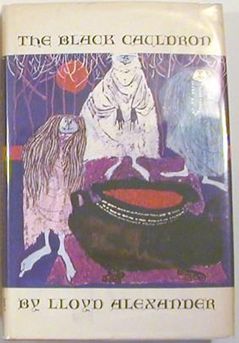
Literature Review: "The Black Cauldron" (1965)

This week, in honor of Lloyd Alexander's birthday on January 30th, I wanted to discuss the second book in my favorite fantasy series when I was growing up"The Black Cauldron" from "The Chronicles of Prydain":


taking place more than a year after "The Book of Three," "The Black Cauldron" continues the story of Taran the Assistant Pig-Keeper.

he's a little older and wiser but still gets constantly trolled by
Ellidyr, Prince of Pen-Llarcau,

Newbury Honor book

By "favorite," I mean that I liked the Chronicles of Prydain more than any other fantasy work in grade school, including the Lord of the Rings.  To me, it was far easier to relate to being an Assistant Pig-Keeper than a hobbit or a Dúnadan ranger.  Now than I'm older, I appreciate and respect LoTR better but Prydain will always have a dear place in my heart.

Speaking of both series, Messr Alexander has sometimes been accused of ripping off Professor Tolkien's Middle Earth works but, in fact, both Prydain and Middle Earth draw inspiration from a number of the same myths and folktales, most notably the Mabinogion.

"The Book of Three" begins with an orphan named Taran who is on the cusp of manhood and who yearns to become a great hero.  Unfortunately for him, he's stuck on a remote farm that's also home to his guardian, retired soldier Coll, and the great wizard Dalben.  Taran is rather full of youthful arrogance and more than a bit bratty and naïve, which sounds more than a bit like this guy:


While Taran is grousing and daydreaming, Coll puts him in charge of Hen Wen, the oracular white pig.  Unfortunately, that same day,  Hen Wen runs away, despite Taran's best efforts, because she is realizes she is being hunted by the Horned King, the war leader of the Dark Lord Arawn!

Taran heads after Hen Wen to try to get her back and runs smack dab into his hero, the High Prince Gwydion!  An unexpected adventure ensues and, on the way, he meets various companions, faces darkness and danger, encounters extraordinary beings and learns that "being a hero" is rather different from his daydreaming.

"The Book of Three" an epic story of the struggle against a Dark Lord but is also filled with understandable and memorable characters facing very human problems.  Like Ursula K. Le Guin's wonderful "Wizard of Earth Sea" (which I discussed last year), "The Book of Three" creates a brilliantly realized fantasy world yet the writing is also sophisticated and the characters are grounded.


Messr Alexander is able to retain the fairy tale elements whilst also giving us characters who feel pain and yearning.  The best and most touching part of the book, IMHO, is at the end when maturity begins to dawn upon Taran, who, when asked about what reward he would like, chooses to leave childish things behind and merely wishes to return home.


it is


Far be it from me to contradict Messr Alexander (the person who actually coined the phrase "High Fantasy"), but this tale isn't how I usually think about the term:
non-gritty low fantasy, I think - magic is rare and the main characters aren't super-heroic


The cauldron-born are indeed very memorable


first multi-part fantasy series that unfolded over a series of years

Here is the The Chronicles of Prydain segment from the excellent Lloyd Alexander documentary:

https://www.youtube.com/watch?v=sRQGPZt5Pc8


Monday, January 22, 2018

Literature Review: "The Tower of the Elephant" (1933)

This week, in honor of R.E. Howard's birthday on January 22nd, I wanted to give a shout out to another ripping yarn by the greatest of Swords & Sorcery authors"The Tower of the Elephant":


adapted as part of the 1982 Conan the Barbarian film.


owned by the evil sorceror Yara

black magic


mystery

Ahead of him he saw, looming against the sky, the Tower of the Elephant. He mused, wondering why it was so named. No one seemed to know. He had never seen an elephant, but he vaguely understood that it was a monstrous animal, with a tail in front as well as behind. This a wandering Shemite had told him, swearing that he had seen such beasts by the thousands in the country of the Hyrkanians; but all men knew what liars were the men of Shem.

gonzo, sci-fi elements

D&D adventure

meet up of PCs

Conan sensed the man's great belly shaking in laughter, but it was not derisive. "By Bel, god of thieves!" hissed Taurus. "I had thought only myself had courage to attempt that poaching. These Zamorians call themselves thieves—bah! Conan, I like your grit. I never shared an adventure with anyone, but by Bel, we'll attempt this together if you're willing."

compassion

Tears rolled from the sightless eyes, and Conan's gaze strayed to the limbs stretched on the marble couch. And he knew the monster would not rise to attack him. He knew the marks of the rack, and the searing brand of the flame, and tough­souled as he was, he stood aghast at the ruined deformities which his reason told him had once been limbs as comely as his own. And suddenly all fear and repulsion went from him, to be replaced by a great pity. What this monster was, Conan could not know, but the evidences of its sufferings were so terrible and pathetic that a strange aching sadness came over the Cimmerian, he knew not why. He only felt that he was looking upon a cosmic tragedy, and he shrank with shame, as if the guilt of a whole race were laid upon him.